
Ten minutes,
not three days.
Speed and simplicity, not a new target. The test measures progesterone — the same analyte as a lab ELISA — in a couple of drops of camel whole blood. No separation, no filtration, no lab. Pregnant camels exceed 3 ng/mL by day 20 post mating; the 2 ng/mL cutoff turns the strip positive.
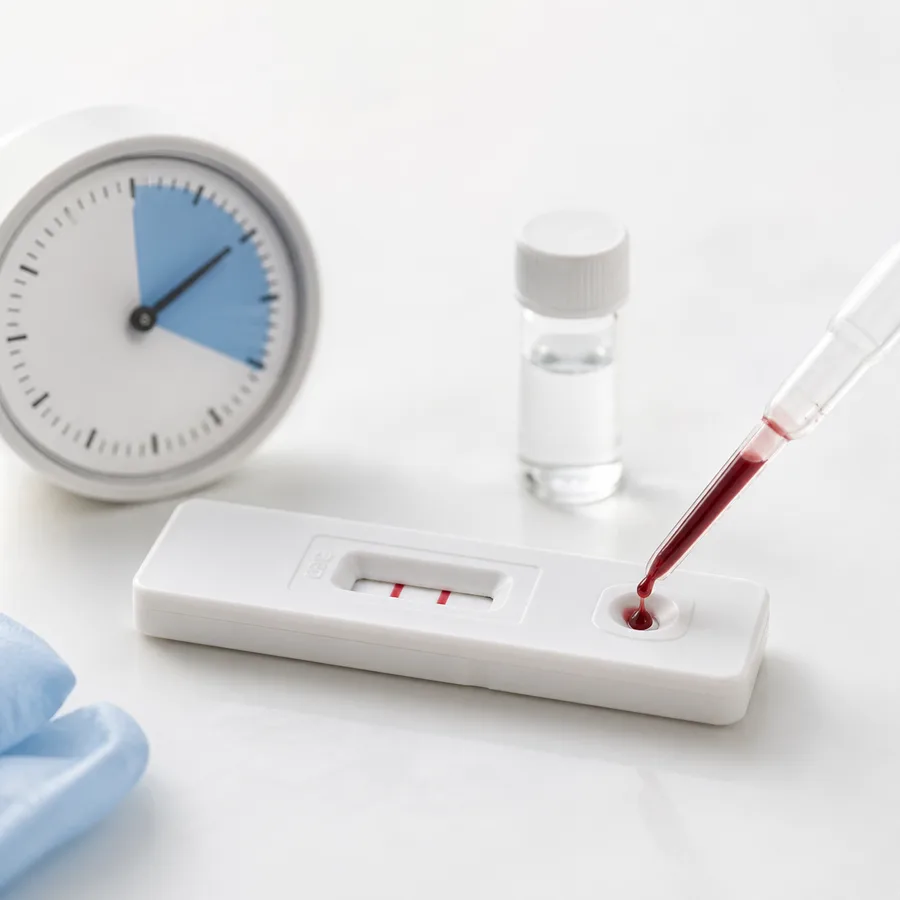
Progesterone, measured in the field.
In a pregnant camel, the corpus luteum sustains progesterone production well past the non-pregnant cycle drop. By day 20 post mating, progesterone exceeds 3 ng/mL. The test uses a 2 ng/mL cutoff — a conservative floor that preserves sensitivity while rejecting baseline noise.
Progesterone target
Competitive lateral-flow immunoassay with an anti-progesterone monoclonal antibody on the test line.
2 ng/mL cutoff
The test line fades above 2 ng/mL. Pregnant camels at day 20 are typically above 3 ng/mL — a clean margin.
Whole blood only
A couple of drops of whole blood from the jugular. No centrifuge, no separation, no filtration — the strip handles sample preparation in the membrane.
When the test turns positive.
Progesterone stays elevated through gestation in pregnant camels and drops back to baseline within two weeks in non-pregnant cycles.
Mating
Reference day. Progesterone baseline, < 1 ng/mL.
Corpus luteum phase
Progesterone rising in both pregnant and non-pregnant camels — not yet discriminating.
Pregnant: > 3 ng/mL · Cutoff: 2 ng/mL
In pregnant camels, progesterone exceeds 3 ng/mL. In non-pregnant cycles, it has already dropped below the 2 ng/mL cutoff. The test reads positive.
Detection window opensUltrasound becomes reliable
Transrectal ultrasound by a trained veterinarian can confirm a vesicle.
Conventional confirmation
The earliest point at which most existing field methods can confirm pregnancy.
The same day as ELISA. Without the lab.
Progesterone ELISA is the established reference method at day 20 — but it requires a laboratory, trained technicians, and one to three days to return a result. The test delivers the same answer in the same field visit.
Will be validated on >500 samples in the UAE.
Peer-reviewed data.
Validation results and assay performance data will be published in peer-reviewed journals following completion of the UAE field study.
Field validation manuscript in preparation.